back
Tarifpolitik

WSI: Key research topics: Wage policy, collective bargaining and industrial relations

Wage policy, collective bargaining policy and industrial relations have been the main fields of expertise in WSI research and public policy advice for decades.

Trade unions, works councils and employers' associations are among the key players for the representation and implementation of employee interests. Research activities focus mainly on the interactions between these players. A panel survey among German works councils provides a unique empirical basis for analyses on the corporate and national level. The WSI Collective Agreement Archive is the major German information centre on developments concerning collectively agreed wages. Research on Germany is complemented by active participation in international networks of scholars investigating wage standards, industrial relations and trade union strategies and perspectives on the European and global level.
 

Main research topics

collective bargaining in Germany: documentation and analyses - trends in collective bargaining and perspectives of future stabilisation - collective bargaining in Europe und European governance - analyses on works and staff councils - trade unions: organisational problems and organisational action; trends in industrial action - the role of employers’ associations
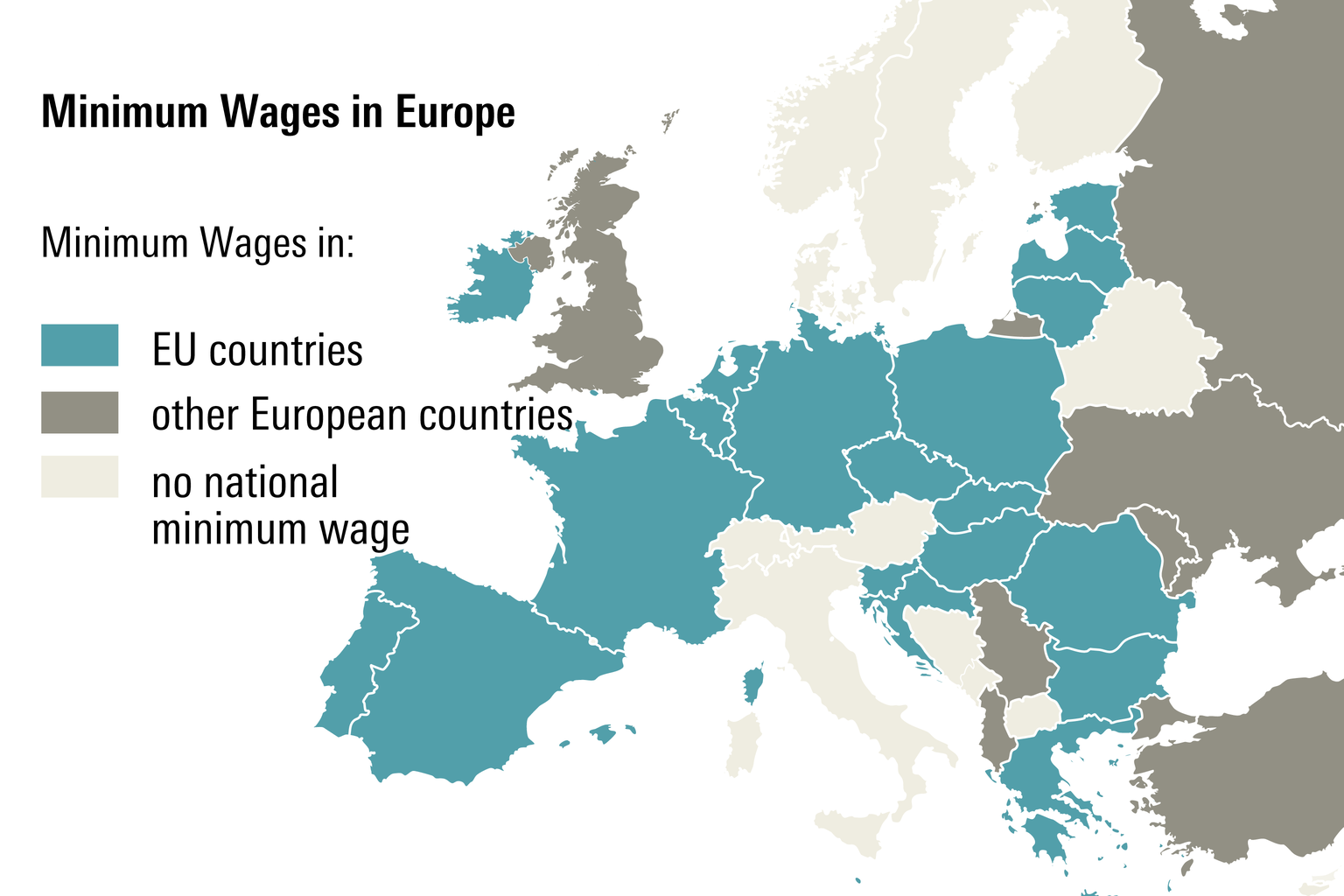
WSI Minimum Wages Database

Data, graphs and an interactive map give an updated overview of the development and amount of minimum wages in the EU and selected OECD countries.

Selected Publications

Malagardē, Athēna / Sengayrac, Simon-Pierre / Schulten, Thorsten : The minimum wage in Greece, France and Germany

The study provides a comparative overview of the new mechanism for setting the statutory minimum wage in Greece in relation to the French and German models.

Müller, Torsten / Schulten, Thorsten : After Landmark EU Court Judgement: The EU Minimum Wages Directive Is Alive and Kicking

The landmark ruling validates the directive's approach to adequate wages and collective bargaining, dealing only minor setbacks to its implementation across Europe.

Eurofound 2025 : Digitalisation of social protection

The report focuses on the digitalisation of front- and back-office processes in monetary social benefits. The automation removes the need to apply and prevents non-take-up, but people in atypical situations are often excluded from digital processes.

Schulten, Thorsten / Lübker, Malte : Germany’s Minimum Wage Hike In Accordance With The European Minimum Wage Directive

The German Minimum Wage Commission has, for the first time, recognised 60 % of the median wage as a formal reference point for the statutory minimum – a decisive policy shift bringing Germany into line with the EU Minimum Wage Directive.

Erol, Şerife / Kärcher, Anneliese / Schulten, Thorsten / Walser, Manfred : Germany’s Subcontracting Ban in the Meat Industry

The European Parliament is preparing a report on abusive subcontracting practices across the EU. The experience in the German meat industry has demonstrated that a ban on subcontracting can be a suitable instrument to combat extreme forms of exploitation.

Schulten, Thorsten : Collective bargaining and public procurement in Germany

Public procurement is of great economic importance and provides the state with considerable market power. The paper analyzes the current status of labour clauses in regional public procurement laws and the latest discussions on a new national procurement act for public contracts at federal level in Germany.

Thorsten Schulten and the WSI Collective Agreement Archive : ANNUAL REPORT OF THE WSI COLLECTIVE AGREEMENT ARCHIVE

The new report provides an overview of collective bargaining agreements by industry and region, branch-level minimum wages, and collective bargaining regulations on workloads and working hours.

Müller, Torsten / Schulten, Thorsten : The road to 80 % collective bargaining coverage

The Directive on Adequate Minimum Wages obliges the EU Member States with collective bargaining coverage of below 80 % to establish action plans to promote collective bargaining. The Policy Brief presents possible concrete measures.

Interview with Daniel Seikel, 24.01.2025 : THE EUROPEAN TAILWIND FOR POVERTY-PROOF MINIMUM WAGES WOULD BE GONE

On January 14, the Advocate General at the ECJ recommended that the EU minimum wage directive be annulled. How likely is it that the judges will follow his vote? And what would the consequences be?

Schulten, Thorsten / Müller, Torsten, 22.01.2025 : EU Minimum Wage Directive Before the European Court of Justice: It’s Not All Over Now…

EU’s minimum wage directive under threat: Advocate General’s opinion sparks legal and social turmoil across Europe.

Toralf Pusch, Hartmut Seifert : Company-Based Measures Securing Employment During the Pandemic

The article analyses measures agreed upon by management and works councils to secure jobs during the pandemic, based on the WSI staff and works council survey. Monetary concessions are less common than measures relating to working hours.

Martin Behrens, Wolfgang Brehmer, Yolanda Grift, Sarai Sapulete, Annette van den Berg, Arjen van Witteloostuijn : Servant of three masters?

Comparing competing demands of representation, integration and solidarity – Dutch vis-à-vis German works councils: Data show that despite very similar institutional settings, there are differences in the priorities works councils set in the two countries.

Behrens, Martin : Establishment-Level Conflict Management in the Time of the COVID 19-Pandemic

Drawing on a large-scale study of German works councils, the author investigates whether and how works councils contribute to resolving work-related conflict under the severe conditions caused by the pandernic.

Müller, Torsten / Schulten, Thorsten : The Collective Bargaining Directive in Disguise

The new book provides an all-encompassing commentary on the EU Directive on Adequate Minimum Wages. Torsten Müller and Thorsten Schulten show how the directive aims to strengthen collective bargaining.

Müller, Torsten / Schulten, Thorsten : TRADE UNION STRATEGIES TO BOOST COLLECTIVE BARGAINING

A new study gives an excellent overview of the initiatives currently under way to strengthen collective bargaining in the member states of the EU. Torsten Müller and Thorsten Schulten have provided expert input on Germany.

Eurofound 2024 : Minimum wages for low-paid workers in collective agreements

In this pilot project, Eurofound successfully established the feasibility of, and piloted, an EU-wide database of minimum pay rates contained in collective agreements related to low-paid workers.

Thilo Janssen, 27.07.2023 : From inflation shock to a sharp distributional conflict

Wages have fallen behind inflation, while profit-taking has not only fuelled price rises but reduced the labour share – a significant problem for distributional justice, with socially explosive potential.

Müller, Torsten / Schulten, Thorsten : Germany: Different worlds of trade unionism

The book offers a comprehensive comparative overview of the development, structure, and policies of trade unions in all 27 Member States of the EU from 2000 to 2020. Torsten Müller and Thorsten Schulten analyze the developments in Germany.

Janssen, Thilo / Lübker, Malte : WSI European Collective Bargaining Report 2022 / 2023

Employees in the EU have suffered a dramatic loss of purchasing power: Real wages have fallen by 4 % in 2022 because of persistent inflation – driven initially by energy prices, but increasingly by higher profit margins.

Müller, Torsten / Schulten, Thorsten / Drahokoupil, Jan : Job retention schemes in Europe during the COVID-19 pandemic

Job retention schemes during Corona were designed in quite different ways in the EU member states. An analysis with a view to the role of collective bargaining policy and employee representation structures and a list of criteria for minimum standards that good systems should comply with

Lübker, Malte / Janssen, Thilo 07.09.2022 : Are workers going to pay the bill for Putin’s war?

Real wages could fall by 2.9 per cent in the European Union in 2022. The depth and breadth of this wage decline are unprecedented. To avoid workers alone paying the bill for Putin’s war, fair wage settlements are needed.

Martin Behrens/Andreas Pekarek : Delivering the goods? German industrial relations institutions during the COVID-19 crisis

Based on a large-scale study of German employees, this paper examines whether and how the institutions of the dual system of employee representation in Germany have succeeded in mitigating the impact of the pandemic on employees.

Martin Behrens : German Employers´ Associations and their Strategy of Deliberate Neglect

More and more of EAs´ member companies choose not to be covered by a multi-employer agreement. The study presents organizational functions and structures and examines the causes of the ongoing weakening of multi-employer bargaining in Germany.

Torsten Müller/Thorsten Schulten, 01.07.2022 : Minimum-wages directive—history in the making

The EU minimum wages directive is a milestone in the fight against in-work poverty. Now, it is more than ever up to the national political actors to raise minimum wages significantly and to strengthen collective-bargaining coverage.

Thorsten Schulten and the WSI Collective Agreement Archive : ANNUAL REPORT OF THE WSI COLLECTIVE AGREEMENT ARCHIVE

The new report provides an overview of collective bargaining agreements by industry and region, branch-level minimum wages, and collective bargaining regulations on workloads and working hours.

Thorsten Schulten, 08.02.2022 : Germany on the way to adequate minimum wages

The German Ministry of Labor has presented a draft Minimum Wage Increase Act, which is also a strong signal of support for the EU Minimum Wage Directive.

Torsten Müller/Thorsten Schulten, 26.11.2021 : More ambitious European minimum-wages directive demanded

EU minimum wages: In comparison with the original commission proposal, the EMPL report adopted on 25.11.2021 marks a clear improvement. The confirmation by the plenary of the European Parliament has strengthened the negotiation mandate.

Thorsten Schulten, 05.11.2021 : RE-STRENGTHENING COLLECTIVE BARGAINING: EXPERIENCES FROM GERMANY

The erosion of collective bargaining and approaches for a re-strengthening: Organizing, the extension of collective agreements and labour clauses in public procurement. Presentation at the FES-UGT conference in Lisbon

Thorsten Schulten/Torsten Müller : A paradigm shift towards Social Europe?

The adoption of the EC-Directive on adequate minimum wages would mark a significant step towards a more “Social Europe”. The debate on the directive is, however, shaped by various political and legal fault lines so that its adoption is anything but certain.

Routledge 2021 : Minimum wage regimes

Employing cross-country comparisons, sector studies and single country accounts of change, this new book relates institutional and labour market settings, actors’ strategies and power resources with policy and practice outcomes.

Martin Behrens, Andreas Pekarek : Divided we stand?

Coalition Dynamics in the German Union Movement: What drives union strategy? Selective benefits or public goods? Taking the German case over the period 1964 to 2018, the article investigates the logics shaping unions coalitions.

WSI Collective Agreement Archive : Collective Bargaining under the conditions of the Coronapandemic

The 2020 bargaining round took place in a context dominated by the Covid-19 pandemic: Agreed pay rose by an average of 2.0 per cent in 2020, i.e. due to Corona, at a much lower rate than in preceding years.

Malte Lübker/Thorsten Müller : WSI-Minimum Wage Report 2021

The EU Commission's minimum wage initiative aims to achieve adequate minimum wages that enable employees to enjoy a decent standard of living wherever they work. 60% of the median wage is needed for this - but Germany is still a long way from achieving this.

Vladimir Bogoeski, 04.02.2021 : Beyond protection: towards democratizing work in the meat industry

The Occupational Safety and Health Control Act: a major step forward for better working conditions in the meat industry. The next step: the active involvement of all employees in trade union structures and co-determination.

Serife Erol/Thorsten Schulten, 26.01.2021 : An end to wage-dumping in the German meat industry?

Labour costs in the German meat industry have been significantly lower than in other major European meat-producing countries. Will the new German legal framework lead to an end to wage-dumping?

Serife Erol/Thorsten Schulten : Renewing labour relations in the German meat industry

Low-cost production exploiting migrant workers: our new report highlight the need for action against cheap production and poor working conditions in the German meat industry. New legislation banning contract work is a chance for better working conditions. Also urgently needed: an industry-wide collective agreement.

Torsten Müller/Thorsten Schulten : Minimum wage directive: Yes - but ...

The draft minimum-wage directive is a crucial first step but more needs to follow on the way to a social Europe.

Torsten Müller/Thorsten Schulten : The European minimum wage will come—but how?

In June the European Commission published a further consultation paper on possible measures to introduce fair minimum wages in the European Union. It remains open, however, what exactly the commission means by ‘fair minimum wages’ and how they can be guaranteed.

Thorsten Schulten/Torsten Müller : Minimum Wage Regimes in the European Union

The study provides a comparative overview of the current minimum wage situation in all 27 EU countries plus the UK and shows how urgent the problem of 'in-work poverty' is in the EU.

Torsten Müller/Thorsten Schulten : Short-Time Work in Europe

The meaning of short-time work in different EU countries, and the importance of the SURE program

Torsten Müller, Thorsten Schulten : Short-time work in Europe

About 27% of all employees in the EU, UK and Switzerland are working short time. How do support schemes differ across Europe? What are the key criteria for a fair short-time work scheme in times of COVID-19?

Annual report of the WSI Collective Agreement Archive : Collective Bargaining in Germany 2019

With a nominal increase of 2.9 per cent for 2019, agreed pay rose nearly as much as in the preceding year. Set in the context of the past two decades, this represents one of the highest rates of increase and was exceeded only, and then only marginally, in 2014 and 2018. Given the modest and falling rate of consumer price inflation of 1.4 per cent, real pay grew by 1.5 per cent in 2019.

Transfer Vol. 25 (3), 2019 : Europe: From Minimum to Living Wages

Minimum wages are often set only at a rather low level, which does not allow for a decent standard of living. More recently, however, many European countries have seen political initiatives for a more substantial increase of minimum wages. As analysed by Thorsten Schulten (WSI) and Torsten Müller (ETUI), these initiatives fit quite well to the concept of a European minimum wage policy.

Martin Behrens, Heiner Dribbusch (eds.), special issue 2019 : German Industrial Relations - Dynamics and Perspectives

The system of German industrial relations aroused lively interest following the corporatist crisis management of 2009/2010, which was credited with ‘Germany’s jobs miracle’. In 2019, it is apparent that although works councils and multi-employer collective bargaining are still alive, labour relations as a whole are undergoing substantial changes.

Heiner Dribbusch (WSI)/Peter Birke (University of Goettingen): FES Study : Trade unions in Germany: Challenges in a time of transition

Germany after the crisis: the economy has recovered, unemployment has fallen. However, many challenges for trade unions remain: precarious jobs, digitalisation, the decline of collective bargaining coverage. New aspects: The shift to the far-right in society and the migration caused by the global refugee crisis touching the question of trade union solidarity. The brochure provides information on the political context, recent membership development and density, along with assessments on approaches and controversies concerning trade union policies.