
Source: Christian Ohde
Dr. Marian Jacobs,(Climate Neutrality Foundation), 16.04.2026: The heating-sector in Germany: Why collective infrastructure is key to a just transition
Two-thirds of households in Germany cannot afford to achieve carbon neutrality on their own. A socially just heating transition requires collective solutions.
The heating transition risks failing due to its reliance on individual incentives. Two thirds of households in Germany cannot organise their own climate neutrality. They lack the necessary funds to install a heat pump in their home, for example. At the same time, the costs of running a fossil fuel heating system will keep rising. For a socially just heating transition, collective solutions are therefore needed instead of individual responsibility. Historical successes in German history show that comprehensive infrastructure is created through public services, not through subsidy programmes. For a socially just heating transition, Germany needs binding heating plans, local authorities and public financing structures.
An example that is typical of many
Let’s imagine a family living in a detached house, somewhere in a medium-sized town in Germany. The oil-fired heating system in the basement dates from the 1990s, and it is clear that it will soon need replacing. The local contractor provides a quote for a new heat pump, but the family lacks the necessary financial reserves for the investment. Although they own a property, that does not mean they have €15,000 to spare for a new heating system. The family is therefore unable to install a new heating system in their home. In Germany, government funding supports the transition to alternative energy sources, called federal subsidy for energy-efficient buildings (Bundesförderung für effiziente Gebäude, BEG). Since 2024, higher subsidy rates have applied to the replacement of heating systems. But even these current subsidy rates of up to 70% under the BEG cannot change this. If district heating were available, it would be cheaper, but the nearest grid is three streets away and is unlikely to be extended this far. The family is therefore waiting, paying rising gas prices and hoping that someone will find a solution for them (Umweltinstitut München 2025).
This situation is no exception; it affects millions of households in Germany. Yet there is actually a widespread desire for climate protection at people’s homes, as survey results from the Climate-Neutral Germany Initiative (IKND – Initiative Klimaneutrales Deutschland) show: those who have to invest in their own homes themselves are, across all political affiliations, generally willing to install a heat pump in their house.
However, the family in our example is not replacing their heating system to protect the climate, but because the old one has broken down. Particularly during the summer months before the heating season, many homeowners face the question of whether their heating system will last another winter or needs replacing. The family therefore does not need to be able to afford the climate transition, but rather they need to be able to afford a modern heating system. Otherwise, they would be indirectly forced to install a technologically outdated heating solution such as a gas boiler. Heat pumps have long since ceased to be merely a contribution to climate protection; they are technically and economically sensible. There is no more efficient way to provide heat: in an existing building, a heat pump can, on average, generate three kilowatt-hours of heat from one kilowatt-hour of electricity. This success of the heat pump is also reflected in official figures from the Association of the German Heating Industry (BDH - Bundesverband der Deutschen Heizungsindustrie): In 2025, more heat pumps than gas heating systems were sold for the first time. Overall, however, 12 per cent fewer heat generators were sold than usual, suggesting that households are postponing investment in new heating technology. The crisis is therefore growing, and the heating transition is becoming less and less effective for most people. Rising gas prices, which are set to almost triple by 2035, are putting further pressure on many households (Bundesinstitut für Bau-, Stadt- und Raumforschung 2023).
The growing crisis in the home
German climate policy in the building sector is based on a simple idea: the price of CO2 makes fossil fuel heating more expensive, the state offers subsidies for climate-friendly alternatives, and households respond rationally to these incentives. They gather information, weigh up their options, apply for funding and invest in their property. So much for the theory.
Reality looks quite different. An analysis by the Social Climate Council (Sozial-Klimarat) shows that only around a third of German households are actually in a position to follow this logic. These are homeowners with sufficient capital, time and knowledge to navigate the complex funding landscape and manage five-figure investments. The remaining two-thirds are held back by structural barriers that no subsidy programme, however well-intentioned, can overcome, or by capital constraints, as in the case of the family from the example above. The forthcoming Building Modernisation Act (Gebäudemodernisierungsgesetz) further increases the complexity for households through the potential use of green gases or green heating oil.
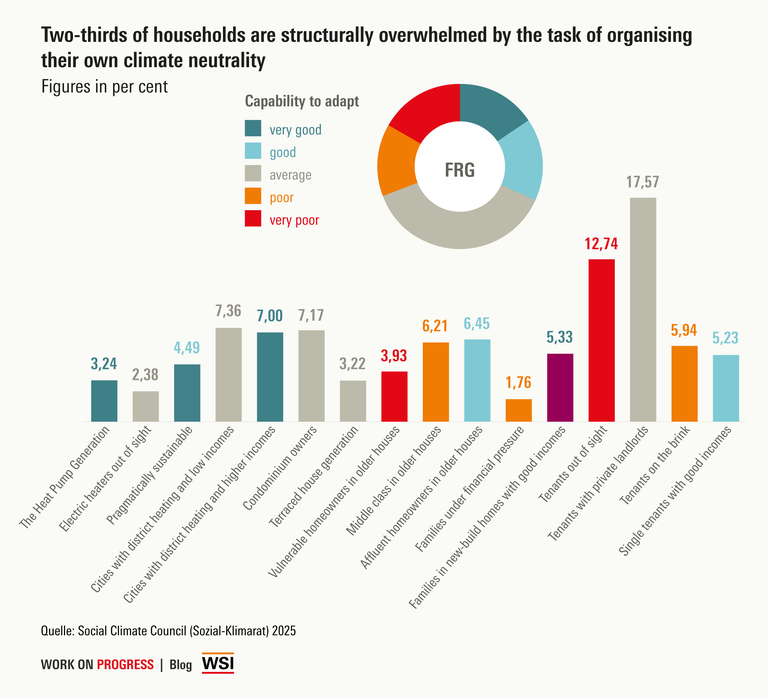
Source: Social Climate Council
In addition to homeowners, there are tenants, who make up 50% of all households in Germany. They have no say in how their heating is managed, yet they bear the costs when the landlord carries out modernisation work: up to eight per cent of the investment cost can be added to the basic rent each year. A heat pump costing €25,000 means several hundred euros more rent per year, permanently. Whilst the subsidy received by the owner reduces the costs passed on to the tenant, an increase in the basic rent of several hundred euros per year is financially unsustainable for many. Finally, there are owners of multi-family properties who face a problem all of their own. They must reach agreements with other parties and grapple with complex ownership structures. Often, they fail simply because of the sheer scale of the coordination task. No funding programme can solve this problem.
The distributional effects of the current subsidy policy are serious: an analysis of the subsidies shows that a large proportion of the BEG subsidy programme went to the top 10 per cent of households. An analysis of the funding actually disbursed supports the argument that subsidy programmes always have a regressive effect. When offers need to be compared, contractors coordinated and applications filed, those with plenty of time and knowledge have an advantage. The income bonus introduced in 2024 cannot change this. Despite a 30 per cent funding supplement for households with a taxable household income of up to €40,000, the socio-economic distribution had not changed significantly by 2023 ((Prognos AG/ifeu/FIW/ITG 2025; Prognos AG/ifeu/FIW/ITG 2026). The figures therefore speak for themselves (see Figure 2 below): the federal subsidy for energy-efficient buildings (BEG) funding scheme is too complex, and the heating transition in its current form is a redistribution programme from the bottom up.
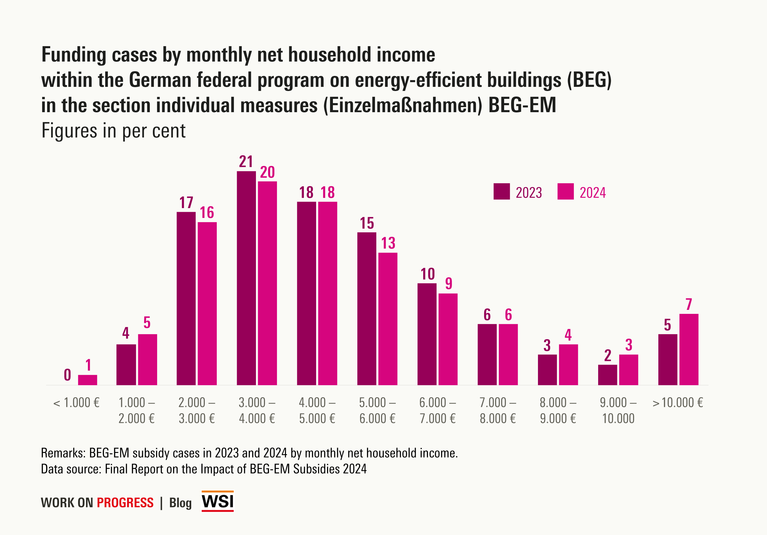
Source: Prognos AG/ifeu/FIW/ITG
The market’s cherry-picking
The problems are not limited to the household level. Systemic failures are also evident in collective solutions, such as district heating networks. Heat plans are currently being drawn up in around 11,000 German local authorities. These plans identify where district heating should be developed and where decentralised solutions such as heat pumps make more sense. Yet there is a gap between plan and implementation, as the heat plans are not binding.
District heating networks are capital-intensive infrastructures with long amortisation periods. It therefore often takes decades for the investment in a district heating network to pay off. Private investors only build them where the conditions are right from a business perspective: Dense development, affluent customers, low development costs. These areas can be called ‘cherries’. They are lucrative and get developed first. The less attractive areas, the ‘lemons’, remain. They do appear in the heating plans, but no investor moves in.
The result is that the market picks the ‘cherries’, whilst the state is left to deal with the ‘lemons’. The problem is not new. We see the same phenomenon in other infrastructure sectors, such as broadband roll-out: private providers develop lucrative areas, whilst rural regions wait for state funding, which in turn involves enormous bureaucratic costs. The approved funding budget for gigabit expansion now stands at 38 billion euros, and yet gaps remain. In the case of heat supply, there is an additional complication: Unlike with electricity or water, there is no clear responsibility for the infrastructure. No one is obliged to build or operate a heating network. Municipal heating planning is a planning tool, but it does not create an obligation to implement. The state is therefore relying on voluntary action and cannot guarantee it.
The forgotten history of successful infrastructure
A look back at the successful completion of major infrastructure projects in Germany is very revealing. The telephone network of the Federal Post Office (Bundespost) is an instructive example. In the 1960s, barely a third of households had a telephone connection. Twenty years later, near-universal coverage had been achieved, and Germany had one of the most technically effective and comprehensive telephone networks in the world (Franke 2023).
This success was not due to individual incentives or funding schemes. The Federal Post was a state monopoly with a clear public service mandate. It built the network using its own funds, financed collectively by the users. The telephones themselves were not sold either but leased to households for use. Households did not have to bear high purchase costs. They paid a small monthly fee and in return received a device that worked and was maintained.
This model dramatically lowered the barriers to entry. It did not matter whether a household was rich or poor, or whether it lived in the countryside or in the city. Everyone received the same service on the same terms. Technical effectiveness – that is, the question of whether everyone was provided for at all – was more important than technical efficiency, that is, the question of whether every single investment was optimised for cost. The state took responsibility for this technical effectiveness.
Unfortunately, this story today gets told in the wrong way. In hindsight, the German Post Office monopoly appears inefficient and bureaucratic, a relic of a bygone era that was rightly privatised. Yet privatisation took place after the network had been established. At that stage, the network was operating at full capacity and generating substantial profits. The public monopoly was the decisive factor in the actual development of the network.
Public service as a leading concept
The term ‘public services’ may sound outdated, but its meaning is highly relevant today. It refers to services that are indispensable for daily life and which should therefore not be left to the market alone: water, electricity, public transport, education, healthcare. These services are organised according to different principles than normal market goods. Comprehensive provision applies even where it is not economically viable. Equal prices for all foster solidarity between urban and rural areas, and between wealthier and poorer regions. Democratic control ensures that public welfare objectives take precedence over profit maximisation.
Anyone who wants to organise the heat transition in a socially just manner has to follow these organisational principles. In the context of this transformation, public services simply mean that the state solves problems that the people cannot solve themselves. To do so, building collective infrastructure is key. Households need heat to live, just as they need water and electricity. No one can do without it. And yet we treat heat supply fundamentally differently from water supply. In the case of water supply, there are municipal authorities with clear responsibilities.
It is clear that sixteen million buildings in Germany will need new heating systems by the target year of 2045. To defuse further transformation conflicts and social hardship in people’s homes, public services must ensure that infrastructure is provided and operated. No household has ever taken individual action to build the drinking water infrastructure; instead, contributions are levied from all property owners, who reinvest the collective investment in the long term. In addition, there are connection and usage obligations that ensure the infrastructure is economically viable. This principle has been tried and tested over time and has guaranteed the successful development of infrastructure.
Another approach is possible
How the heating transition is organised is a political decision. Organising it as a public service would be a historically proven and socially just approach. The first step in this direction would be to clearly define responsibility for infrastructure. Local authorities or regional bodies would have to be obliged to ensure a comprehensive, climate-neutral heat supply. Heating plans would no longer be non-binding recommendations, but binding requirements.
The second step concerns financing. Public bodies can raise capital more cheaply than private investors. They are not reliant on double-digit returns and can plan over longer horizons. Financing structures fed by public funds and user contributions could finance network expansion without households having to make large one-off payments. Public law already provides instruments for this: contributions can cover up to 100 percent of the investment costs and arise once the building gains the option to connect, not only once a specific contract gets signed. The economic logic behind this: the property gains value through the connection, and the contribution reflects this increase in value. Up to 100 percent of investment costs can be refinanced this way.
The third step would be not only to build infrastructure, such as electricity grids for households, but also to provide them with the end devices. Heat pumps would not need to be purchased as an expensive investment but would be available through rental or leasing schemes. The operator bears the maintenance risk, whilst the household pays a predictable monthly fee. Such models lower the barriers to market entry and enable socially tiered pricing.
What needs to be done now
Scandinavia is already demonstrating how this can be done. In Denmark, over 50 per cent of households are connected to district heating. The networks are predominantly publicly or cooperatively owned and are operated not according to profit-driven logic, but according to supply-oriented logic. The result: affordable heating, high security of supply and a decarbonisation pathway that is socially acceptable.
In Germany, time is running out, and in two respects. In terms of climate policy, we must achieve climate-neutral heating by 2045. In terms of social policy, without a clear plan for building infrastructure, an escalating cost spiral and dwindling acceptance of the energy transition loom. Every year of delay makes the transition more expensive and exacerbates social upheaval. Those who are currently unable to take action are particularly affected, as they must continue to heat their homes using fossil fuels and thus face rising gas and oil prices.
Large-scale infrastructure forms the backbone of a functioning society. Public services were the state’s response to the development of industrial society. They ensured universal access to essential goods and services for society, thereby securing modern life: No one could produce their own water or electricity; public authorities do this on behalf of the state. In the transition to a climate-neutral industrial society, the question of new service providers arises once again: how can we secure nationwide supply of climate-neutral and affordable heat? A planned, coordinated transition would be more efficient than the current chaos of individual decisions. This requires clear and binding planning with concrete implementation steps and responsibilities. Germany has managed this before. It is time to remember this at a political level.
REFERENCES
Bundesinstitut für Bau-, Stadt- und Raumforschung (2023): Forschungsprojekt: Folgen warmer Nebenkosten: Wirkungsanalyse aktueller und zukünftiger Wärmekosten für private Haushalte, Energieversorger und Wohnungsunternehmen. Zwischenergebnisse.
Bundesverband der Deutschen Heizungsindustrie (BDH) (2026): Jahresbilanz: Heizungsabsatz fällt auf niedrigsten Stand seit 15 Jahren. Pressemitteilung vom 01.02.2026.
Franke, Christian (2023): Technikwenden für die Zukunft – Kontinuitäten, Brüche und Gestaltungsprinzipien der Digitalisierung der Telekommunikationsnetze in der Bundesrepublik, in: Weber, Heike (ed.), „Technikwende“? Historische Perspektiven auf soziotechnische Um- und Aufbrüche, Baden-Baden 2023, pp. 145-168.
Initiative Klimaneutrales Deutschland (IKND) (2025): Monitoring Energiewende im Eigenheim.
Prognos AG/ifeu/FIW/ITG (2025): Förderwirkungen BEG EM 2023. Evaluation des Förderprogramms „Bundesförderung für effiziente Gebäude (BEG)“ in den Teilprogrammen BEG Einzelmaßnahmen (BEG EM), BEG Wohngebäude (BEG WG) und BEG Nichtwohngebäude (BEG NWG) im Förderjahr 2023.
Prognos AG/ifeu/FIW/ITG (2026): Förderwirkungen BEG EM 2024. Evaluation des Förderprogramms „Bundesförderung für effiziente Gebäude (BEG)“ in den TeilprogrammenBEG Einzelmaßnahmen (BEG EM), BEG Wohngebäude (BEG WG) und BEG Nichtwohngebäude (BEG NWG) im Förderjahr 2024.
Sozial-Klimarat (2025): Die Persona-Analyse des Sozial-Klimarat: Deutsche Haushalte und ihre Anpassungsfähigkeit in der Klimatransformation (Update).
Umweltinstitut München (2025): Kosteneinsparungen einer frühen Gasnetzstilllegungsplanung.
The article in German language: Wärme als öffentliche Aufgabe
This blog series is a collaboration between the WSI and the Next Economy Lab (NELA). The WSI Annual Conference 2025 entitled "Crises, struggles, solutions: transformation conflicts in socio-ecological change" also addressed the topic. At NELA, this series is part of the project "Team Social Climate Change" in which trade union members from IG Metall and ver.di are being trained as transformation promoters in a cross-union training programme. They learn how to help shape the social climate transition locally and in their companies, how to win supporters and actively counter resistance. The project is supported by the Mercator Foundation.
The articles in the series
- Neva Löw/Sarah Mewes/Magdalena Polloczek: Conflicts over a socially just climate transition (October 8, 2025)
- Markus Wissen: Transformation conflicts and global climate justice (October 9, 2025)
- Neva Löw/Maximilian Pichl: How the climate crisis and global migration are linked (October 13, 2025)
- Silke Bothfeld/Peter Bleses: Equality in the labor market – The challenges of the socio-ecological transformation (October 21, 2025)
- Marischa Fast/Stefanie Bühn/Johanna Weis: Health protection in the context of climate and environmental crises – an issue for the world of work (November 27, 2025)
- Rahel Weier/Miriam Rehm/Neva Löw: How gender attitudes shape climate concerns (January 29, 2026)
- Marian Jacobs: The heating-sector in Germany: Why collective infrastructure is key to a just transition (April 16, 2026)
- Tanja Brumbauer/Sarah Mewes: Wealth and the climate crisis: Can we afford the rich anymore? (May 25, 2026)
- Tom Krebs/Patrick Kaczmarczyk: Green Steel: Why Germany Needs Its Steel Industry (July 8, 2026)
Further articles in preparation
Author
Dr. Marian Jacobs is a Senior Advisor at the Climate Neutrality Foundation. In this role, he addresses key strategic issues related to a socio-economic heating transition and develops new ideas and concepts to accelerate planning and permitting processes in the next phase.