
Quelle: Jochen Tack
Tom Krebs/Patrick Kaczmarczyk, 08.07.2026: Green Steel: Why Germany Needs Its Steel Industry
The transformation of the steel industry is crucial for climate neutrality, economic resilience and democratic stability. Instead of relying on imports, Germany needs to invest in climate-neutral production and infrastructure.
The steel industry is one of the country’s most carbon-intensive sectors. Without its decarbonisation, climate neutrality cannot be achieved. However, the transition to green steel requires investments running into the billions and a fundamental transformation of production processes. This will directly affect tens of thousands of workers at the major sites. Our study shows that those who opt for relocation abroad rather than undergoing this transformation are not only jeopardising climate targets, but also Germany’s economic resilience and social cohesion in the affected regions.
Steel as the foundation of industry
The German steel industry stands at the beginning of key value chains. As a major basic materials industry, it provides an indispensable input for the construction sector, mechanical engineering, the automotive industry and the defence sector. Without steel, there would be no new bridges, railways, wind turbines or tanks. Steel is found in around 75 per cent of the products that play an important role in our everyday lives, ranging from office chairs to wind turbines.
Around four million people are employed in steel-intensive sectors. This accounts for two out of every three industrial jobs in Germany. The steel industry generates around €7 billion in direct value added, while indirectly enabling a further €12.7 billion in downstream sectors.
At the same time, the sector is facing an enormous challenge: steel production is responsible for around 7 per cent of national CO₂ emissions. The transition to climate-neutral processes, particularly hydrogen-based direct reduction (DRI+H₂), is therefore a key decarbonisation project. In a new study, we examine the economic and political costs that would arise if Germany were to opt for relocating steel production abroad rather than pursuing transformation.
A massive investment gap in green steel
Germany is the largest steel producer in the EU, with 37.2 million tonnes of crude steel (2024). In the long term, production demand is expected to reach 40 to 45 million tonnes per year, around 20 million tonnes of which will be primary steel. The share of primary steel production is expected to fall from currently 70 to 50 per cent, whilst secondary steel production from scrap will gain in importance.
However, the planned climate-neutral production capacity of around 6.5 million tonnes is insufficient to meet the future demand for 20 million tonnes of primary steel. The reasons are as follows: ArcelorMittal, one of the world’s largest steel groups, has cancelled its transformation plans for Bremen and Eisenhüttenstadt and turned down €1.3 billion in subsidies. Thyssenkrupp has pursued insufficient expansion targets in Duisburg so far, while Salzgitter AG has postponed the second and third phases of the SALCOS project – an initiative to convert steel production to hydrogen-based direct reduction – by three years. The causes are structural in nature. High and volatile energy prices, a lack of long-term purchase guarantees for green steel and an uncertain political environment make investments too risky from the companies’ perspective. As long as green steel commands a price premium over conventional steel on the market and there is no reliable demand, corporations will shun the transition, even if state subsidies are available. This results in a capacity gap of over 13 million tonnes per year in the primary steel sector alone.
Time is also running out, as a large proportion of existing blast furnace capacity will reach the end of its technical life by the mid-2030s. The last round of refurbishments took place between 2014 and 2017, meaning the next phase of renewal coincides with the phase-out of coal and the switch to direct reduction plants must take place. Without investment decisions in the coming years, the supply of one of Germany’s most important industrial raw materials will be jeopardised.
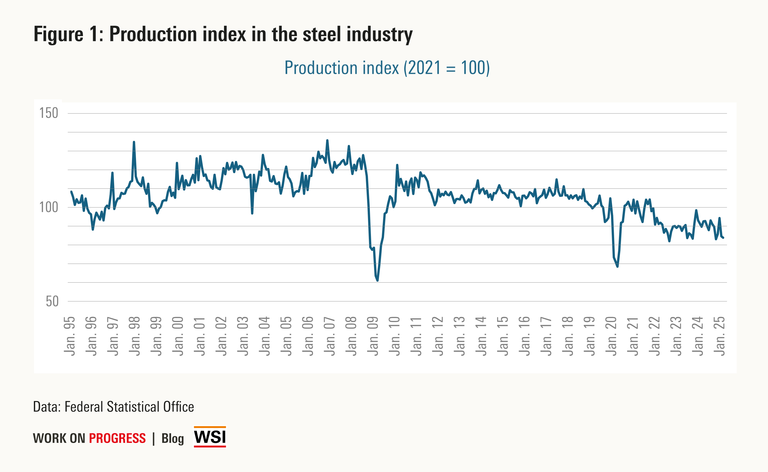
Quelle: destatis
€50 billion loss in value added in the event of a crisis
In our study, we focus on the concept of economic resilience. By this we mean an economy’s ability to absorb global supply or demand shocks. Specifically, we model a scenario in which major steel exporters – such as China, which produces over half of the world’s steel – drastically restrict their exports to Europe due to geopolitical developments. If Germany had relocated its entire steel production abroad in such a scenario, the economic consequences would be severe.
We calculate the costs of a complete loss of domestic steel supply using a supply-side input-output model (Ghosh model), which captures the sectoral interdependencies of the German economy. The results show a loss in value added of up to 50 billion euros per year, equivalent to 1.2 per cent of gross domestic product. This loss comprises two components: Firstly, there is a negative supply effect: the lack of steel would significantly impair production in downstream sectors. The manufacture of metal products (a loss in production value of almost 15 billion euros), mechanical engineering (6 billion euros) and the automotive industry (7 billion euros) would be particularly affected. The losses in gross value added through this channel alone would amount to €24 billion. Secondly, there would be a negative demand effect: the loss of income among private households would further reduce demand for goods. Using an empirically based fiscal multiplier of 1.1, this would result in a further decline in aggregate economic output of around €26 billion.
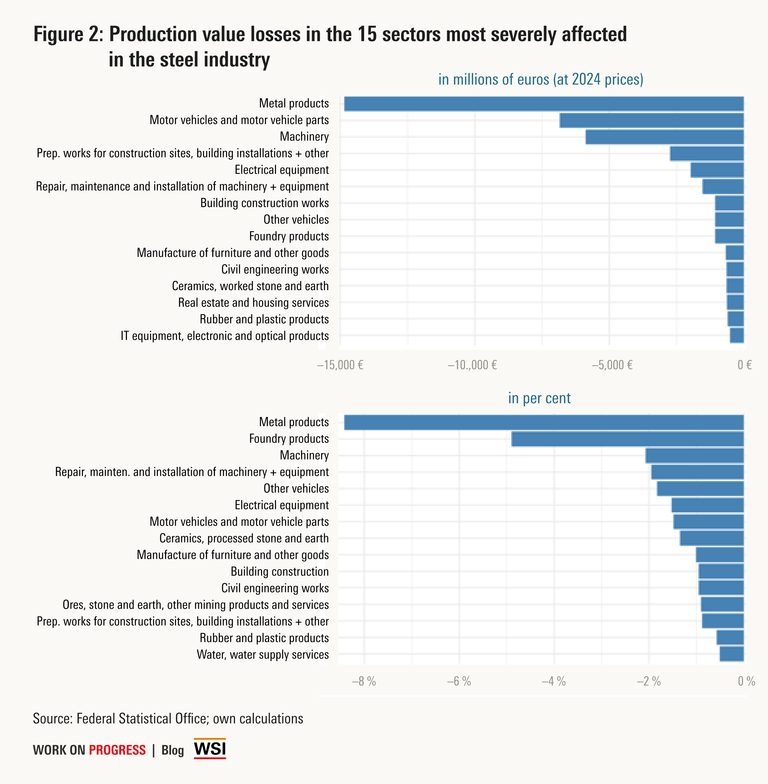
Quelle: destatis; own calculations
Employment effects: regional concentration and political impact
It is important to bear in mind that the economic losses go beyond abstract production figures. In Germany, the steel industry directly supports around 70,000 jobs. Taking into account the indirect and induced effects (i.e. employment in supplier industries and the demand generated by consumer spending), the total employment impact amounts to around 547,000 jobs. Therefore, for every person directly employed in the steel industry, almost eight further jobs are sustained in the rest of the economy.
The regional concentration of the impact is particularly alarming. A relocation would hit the five main centres of primary steel production – Bremen, Duisburg, Eisenhüttenstadt, Salzgitter and the Saarland – the hardest. A recent study by IW Consult illustrates the severity of the situation using the example of Duisburg: a reduction of just 1,000 jobs in the steel industry resulted in the loss of around 5,000 jobs in the region. In the worst-case scenario, involving the loss of 11,000 jobs, the macroeconomic losses in Germany would total just under 55,000 jobs, 13,000 of which would be in Duisburg alone. The city’s GDP would plummet by 6.2 per cent.
The age structure of the workforce exacerbates the problem: 42 per cent of steel industry employees are over 50 years old. Experience of previous structural changes shows that older industrial workers in particular remain unemployed for longer than average after losing their jobs. In the Ruhr region, the average duration of unemployment was around 585 days. Only 14 per cent of those leaving long-term unemployment find regular employment. Those who do find a job again often have to accept significant wage cuts.
Deindustrialisation and right-wing populism: a dangerous dynamic
There is a well-documented empirical link between economic decline in industrial regions and the rise of right-wing populist parties. In the US, decades of job losses in the so-called ‘Rust Belt’ played a decisive role in Donald Trump’s election in 2016 (Autor et al., 2020). In the United Kingdom, the deindustrialised regions of the East and West Midlands voted in favour of Brexit by around 59 per cent, whereas in London and Scotland the figure was only 38 to 40 per cent (Blackaby et al., 2020; Fetzer, 2019).
Therefore, Germany must proceed with caution. A policy that relies on the relocation of industrial value creation and jeopardises jobs in Bremen, Duisburg or Eisenhüttenstadt would effectively be an economic stimulus package for the Alternative for Germany (AfD). In regions that are already characterised by economic uncertainty, a structural shift in the steel industry would exacerbate mistrust of established parties and institutions further.
The outsourcing argument falls short
Critics of a German steel strategy argue that energy-intensive primary steel production should be relocated abroad, whilst further processing should remain in Germany. This argument sounds plausible at first glance, but falls short for several reasons.
Firstly, the resilience of the German economy would be significantly weakened. The argument for offshoring is based on the unrealistic assumption that global supply chains always operate seamlessly. The experiences of recent years – the COVID-19 pandemic, the energy crisis, the war in Ukraine, the Trump administration’s erratic trade policy, and the recent escalation of violence in the Middle East – have proven the opposite. Secondly, the steel industry’s value chain is closely interlinked in technical and logistical terms. For example, Separating pig iron production leads to higher energy costs in the downstream electric arc furnace, as the process heat from the hot iron cannot be utilised. Furthermore, there is no evidence to support the hope that countries such as Spain could compensate for a loss of production in Germany if necessary: the additional capacity planned there amounts to only around 3 million tonnes, wich is a fraction of Germany’s primary steel capacity.
Conclusion: Transformation rather than relocation
As our study shows, the resilience of the German economy depends crucially on whether we succeed in maintaining the steel industry as the industrial backbone and transforming it to be climate-neutral. The investment gap in green steel must be urgently closed. Expanding direct reduction plants and hydrogen infrastructure at all five central sites is a necessity not only for climate policy, but also for economic and socio-political reasons.
A policy that relies on cheap imports not only risks annual losses in value added of up to 50 billion euros in the event of a crisis. It also risks undermining social cohesion in the affected regions. When industrial jobs are lost and there are no credible economic prospects, trust in political institutions and democratic processes erodes. This correlation can be seen in the Rust Belt, the British Midlands and the Ruhr region. The transformation of the steel industry is therefore not merely an industrial policy issue, but a question of democratic stability.
References
Autor, D., Dorn, D., Hanson, G., & Majlesi, K. (2020). Importing political polarisation? The electoral consequences of rising trade exposure. American Economic Review, 110, 3139–3183.
Blackaby, D., Drinkwater, S., & Robinson, C. (2020). Regional variations in the Brexit vote: Causes and potential consequences (IZA Discussion Paper No. 13579). Institute of Labor Economics (IZA).
Fetzer, T. (2019). Did austerity cause Brexit? American Economic Review, 109, 3849–3886.
Hönig, L., & Zink, B. (2025). Structural Break in the Duisburg Steel Region. IW Consult.
Kaczmarczyk, P., & Krebs, T. (2025). Green steel as a central pillar of a resilient economy. Centre of Excellence for Transformation Research, University of Mannheim.
Material Economics. (2019). Industrial transformation 2050: Pathways to net-zero emissions from EU heavy industry.
Prognos, Öko-Institut, & Wuppertal Institute. (2021). Climate-neutral Germany 2045. Study commissioned by Agora Energiewende, Agora Verkehrswende and the Climate Neutrality Foundation.
Verpoort, P., et al. (2024). Decarbonising the EU’s steel industry through green hydrogen imports. Potsdam Institute for Climate Impact Research.
The article in German language: Grüner Stahl: Warum Deutschland seine Stahlindustrie braucht
This blog series is a collaboration between the WSI and the Next Economy Lab (NELA). The WSI Annual Conference 2025 entitled "Crises, struggles, solutions: transformation conflicts in socio-ecological change" also addressed the topic. At NELA, this series is part of the project "Team Social Climate Change" in which trade union members from IG Metall and ver.di are being trained as transformation promoters in a cross-union training programme. They learn how to help shape the social climate transition locally and in their companies, how to win supporters and actively counter resistance. The project is supported by the Mercator Foundation.
The articles in the series
- Neva Löw/Sarah Mewes/Magdalena Polloczek: Conflicts over a socially just climate transition (October 8, 2025)
- Markus Wissen: Transformation conflicts and global climate justice (October 9, 2025)
- Neva Löw/Maximilian Pichl: How the climate crisis and global migration are linked (October 13, 2025)
- Silke Bothfeld/Peter Bleses: Equality in the labor market – The challenges of the socio-ecological transformation (October 21, 2025)
- Marischa Fast/Stefanie Bühn/Johanna Weis: Health protection in the context of climate and environmental crises – an issue for the world of work (November 27, 2025)
- Rahel Weier/Miriam Rehm/Neva Löw: How gender attitudes shape climate concerns (January 29, 2026)
- Marian Jacobs: The heating-sector in Germany: Why collective infrastructure is key to a just transition (April 16, 2026)
- Tanja Brumbauer/Sarah Mewes: Wealth and the climate crisis: Can we afford the rich anymore? (May 25, 2026)
- Tom Krebs/Patrick Kaczmarczyk: Green Steel: Why Germany Needs Its Steel Industry (July 8, 2026)
Further articles in preparation
Authors
Tom Krebs is Professor of Macroeconomics at the University of Mannheim and a member of the Minimum Wage Commission. His research focuses, among other things, on public investment, economic resilience and climate policy.
Patrick Kaczmarczyk is a research assistant at the Chair of Macroeconomics at the University of Mannheim. His research focuses on industrial policy, economic transformation and development.