
Quelle: Zeynep Demir Aslim
Tanja Brumbauer/Sarah Mewes, 21.05.2026: Wealth and the climate crisis: Can we afford the rich anymore?
Climate-damaging emissions are primarily the responsibility of the rich, yet the consequences are borne most acutely by the poorer members of society. Why we need higher taxes on wealth, inheritance and luxury consumption
Whilst many were still in the slow start to the year in January, the news came as a shock: according to calculations by the British NGO Oxfam, by 10 January 2026 the top 1% of the global income distribution had already used up their fair share of the annual greenhouse gas budget (Oxfam 2026). At the same time, it is becoming increasingly clear that the socio-ecological transformation of our economy is a massive undertaking that costs a great deal of money and brings with it existential fears for many people. Workers are afraid of losing their jobs and being unable to afford their livelihoods. To them, an eco-friendly lifestyle seems reserved for the privileged academic middle class. The tense global economic situation further exacerbates the situation (Wirtschaftswoche 2026).
Although the wealthiest members of our society contribute disproportionately to the worsening of the climate crisis (Oxfam 2025, Chancel 2022, Rehm 2025), it is primarily the lower-income sections of the population who primarily bear its consequences. Therefore, it is not surprising that the public debate on the link between the climate crisis and inequality, and the call for redistributive measures that accompany it, is gaining momentum once again (Bolten 2025, Mohren 2026, Krupa 2025).
In this blog post, we will explore the following questions: What are the links between inequality and the climate crisis? Which redistributive measures could help us to achieve our climate targets and bring about a socially just ecological transition in our economy?
The ecological footprint of the wealthy and the ever-widening inequality gap
For years, it has been known that greenhouse gas emissions are distributed very unevenly across countries. Ten countries are responsible for 60 per cent of cumulative emissions. In contrast, the 100 countries that have emitted the least account for less than three per cent (Climate Watch 2026). In absolute terms, Germany is not among the world’s ten largest emitters. In 2023, it ranked 12th with emissions of 669 million tonnes. However, within Europe, Germany has the highest absolute CO₂ emissions (Climate Watch 2026).
International climate policy attempts, with varying degrees of success, to address this imbalance through various compensation mechanisms and to hold the countries with the highest emissions accountable.
However, when looking at emissions per country, what is overlooked is that inequality in greenhouse gas emissions is striking not only between countries, but also within them. Income and wealth distribution play a key role here. Regardless of the country, it is clear that the top income and wealth groups emit, or have emitted, the most.
This issue is becoming increasingly significant due to the growing trend of economic inequality within countries. This is partly because returns on wealth are growing faster than wage income (Piketty 2014) . For instance, Oxfam shows that the wealth of billionaires worldwide increased by 16 per cent last year (Oxfam 2026), whilst wage growth has virtually stagnated. Consequently, the gap between rich and poor is widening. It is not at all easy to define who is considered ‘rich’; often, income is the only factor taken into account. In the German government’s Income and Wealth Report, anyone earning two to three times the median income is classified as rich (BMAS 2025). However, this definition disregards Piketty’s aforementioned finding that rising social inequality is primarily fuelled by high returns on wealth. In this article, we therefore define as ‘rich’ those people who can live comfortably without gainful employment, solely on the income from their assets. This applies to individuals with assets of 2–3 million euros (Friedrichs 2024). The difficulty lies in the fact that asset-based wealth is virtually impossible to measure in this country, as there is no register of assets, and all statistics on existing wealth are based purely on estimates. For this reason, income is very often used as a measure of wealth, since precise figures are available for it. For several years now, Oxfam has been publishing key figures on this growing inequality and regularly analyses data from the Stockholm Environment Institute on the relationship between income and CO₂ emissions in international and global comparisons.
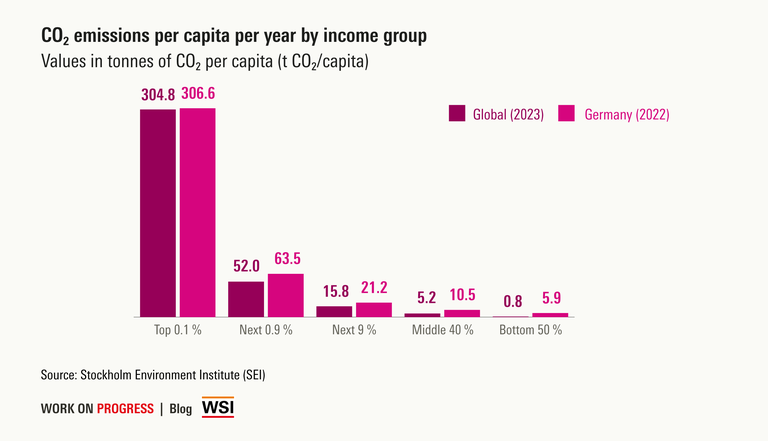
The figures clearly show the vast differences in per capita CO₂ emissions are between income groups. Figure 1 shows that the bottom 50 per cent (USD 3,270 per capita per year) are responsible for just 0.8 tonnes of CO₂ per capita per year worldwide, while the top 0.1 per cent (USD 1,434,250 per capita per year) are responsible for as much as 304.8 tonnes per capita per year (SEI 2026). Therefore, an average person in the top 0.1 per cent is responsible for 381 times more CO₂ than an average person in the bottom 50 per cent.
There are also enormous differences between the top and bottom income groups in Germany. Whilst the bottom 50 per cent (USD 23,890 per capita per year) were responsible for just 5.9 tonnes in 2022, the top 0.1 per cent (USD 880,160 income per capita per year) of the German population averaged 307 tonnes per person per year (SEI 2026)
As can be seen clearly in Figure 1, since Germany is a wealthy industrialised country by global standards, the absolute figures for CO₂ emissions are higher across all income groups. This is particularly evident among the bottom 50 per cent in Germany, who consume seven times more than the global average. However, the main contributors to CO₂ emissions are the higher income groups.
Quelle: SEI
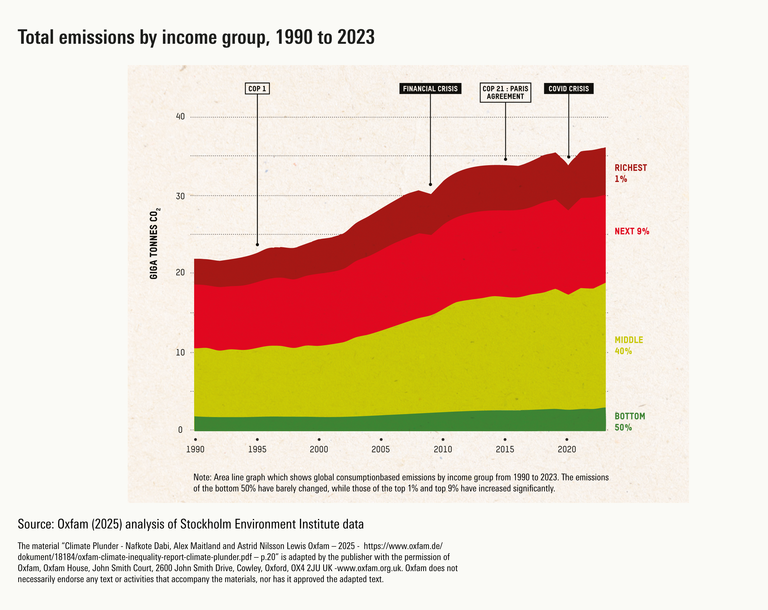
Examining the historical accumulation of emissions on a global scale (Figure 2) reveals that the inequality in CO₂ emissions between income groups has increased dramatically since 1990. Whilst the cumulative emissions of the bottom 50 per cent rose very slightly between 1990 and 2023, a clear upward trend is evident among both the middle 40 per cent, as well as the top 10 and 1 per cent respectively. This indicates that emissions inequality has worsened immensely since the 1990s; the top 10 per cent were responsible for 44 per cent of CO₂ emissions between 1990 and 2023 (Oxfam 2025).
Quelle: Oxfam
Oxfam analyses emissions by different income groups. Although this approach indirectly considers wealth, as returns on assets are included in the income statistics, it is important to emphasise that a comprehensive picture requires consideration both of wealth AND income. Approaches based solely on income data generally focus on consumption-related emissions. Estimates are made of how many emissions are attributable to consumption within an income group. Incorporating wealth into the analysis also allows for the inclusion of CO₂ emissions caused by investments, such as ownership of companies, machinery, or property. For example, if an investor puts their money into a fossil fuel company, their CO₂ emissions would be higher in this analysis than if they were to buy shares that fund a nursery.
As previously mentioned, it is difficult to obtain precise figures on the distribution of wealth, and there are few up-to-date statistics available. Nevertheless, initial important studies by researchers provide empirical estimates.
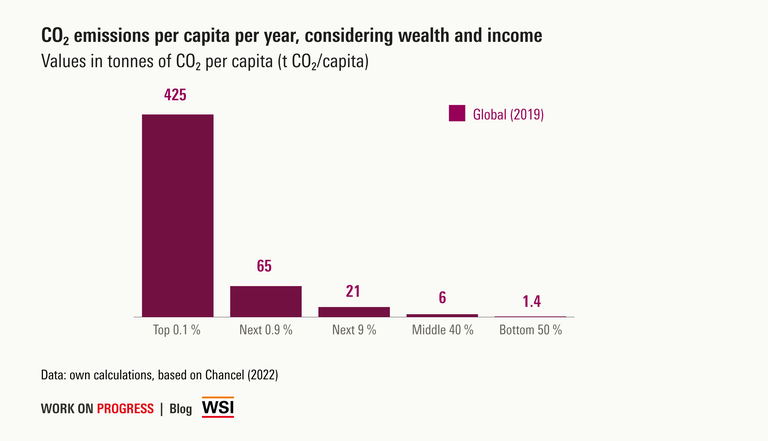
In 2022, Chancel will integrate wealth data alongside income data, thereby taking into account not only consumption-related emissions, but also those attributable to capital holdings and investments (Chancel 2022). Using these datasets, it is possible to calculate the global average figures for the top 0.1 per cent (425 t CO₂ per person per year), the next 0.9 per cent (65 t CO₂ per person per year) and the next 9 per cent (21 t CO₂ per person per year). It becomes clear that the inequality of distribution between these various groups is even greater than when examining the relationship between income and CO₂.
Quelle: NELA
Yet, even though the degree of inequality and the specific figures vary depending on the perspective, one thing is clear: economic inequality leads to inequality in emissions. The richer people are, the larger their ecological footprint. This is due, on the one hand, to the resource-intensive standard of living maintained by many people, particularly the super-rich (billionaires) and the rich (people who can live off the returns on their wealth). Yachts and private jets play a significant role here and are becoming increasingly popular among the world’s wealthiest inhabitants, most of whom are male. For instance, the 20 richest billionaires emit approximately 8,000 tonnes of CO₂ annually, two-thirds of which is emitted by their yachts (Wilk 2021). On the other hand, investments in climate-damaging industries play a role. Even today, the highest returns can still be achieved in the fossil fuel economy (Christophers 2022; Semienuik et al. 2025).
The enormous injustice associated with the disparity in emissions between the rich and poor is exacerbated when we consider that those who contribute the least to global climate change and have the fewest financial resources usually suffer the most from its consequences (IPCC 2022). They have fewer resources to adapt or protect themselves (e.g. by purchasing air conditioning) and are more likely to have pre-existing health conditions. This means that heatwaves, for example, have a greater physical impact on them (Palinkas et al. 2022, Borrell et al. 2006). Furthermore, they have fewer opportunities to deal with the resulting damage (Osberghaus/Abeling 2022), such as rebuilding infrastructure destroyed by extreme weather. At the same time, people from lower income groups have less political participation (Spannagel 2025) and far less influence over the policies adopted to curb climate change and inequality, particularly compared to the rich and the super-rich (Hagelüken 2026). The latter can use their wealth to exert direct political influence through well-funded lobbying organisations and party donations.
One thing is undisputed: if we are to meet the long-term of keeping the global temperature rise to 1.5-degree, as agreed under the Paris Climate, we need to drastically reduce global CO₂ emissions. It is difficult to determine a precise figure for an acceptable average annual per capita CO₂ emission, as this depends on population growth and additional natural and technical sinks that can be realised (UBA 2026). However, based on current knowledge, we can assume that a maximum of 1 tonne of CO₂ per person per year must be reached to achieve net-zero emissions (UBA 2026). As the above figures make clear, we are very far from this target. In Germany, all income groups must significantly reduce their carbon footprint. However, the data also show that the wealthiest individuals are a particularly key starting point for combating human-induced climate change due to the discrepancies between income and wealth groups.
“We can’t afford the super-rich,” climate activists repeatedly declare at protests. In its latest report, the Club of Rome also stated that inequality is now one of the key risks to the climate (Club of Rome and Wuppertal Institute 2024). Their position is clear: the climate crisis can only be resolved if inequality is reduced. But how can this be achieved?
Redistribution measures for a socially just ecological transformation of our economy
One key policy measure is taxing the wealthy. In Germany and Europe, this has once again become a more prominent part of public political discourse in recent times (see Rebhandl 2026, DLF 2026, Vieweger 2026). In November 2025, for instance, a (regrettably unsuccessful) referendum took place in Switzerland that proposed taxing inheritances exceeding 50 million Swiss francs at a rate of 50%, with the aim of using the generated revenue to combat the climate crisis in a socially just manner (Rigendinger 2025). German trade unions also repeatedly speak out forcefully on issues of tax justice and advocate for higher taxation of high net worth individuals and the wealthy (DGB 2026) – albeit with only an indirect link to the transition to a climate-neutral economy.
The measure that has probably been the subject of the most prominent debate is the introduction of a wealth tax. Here, notional returns on assets are calculated and taxed accordingly. In cases where there is no current income from returns, this can lead to a reduction in the stock of wealth (Bach et al. 2026) and, consequently, to a reduction in economic inequality. However, as the level of the assessed return value (i.e. the final tax rate) determines whether wealth concentration is merely slowed down or whether wealth inequality actually decreases, opinions are divided on this point. Concepts calling for a wealth tax of a few per cent are currently under discussion. One such proposal is that of the French economist Gabriel Zucman, who advocates a two per cent tax on wealth exceeding 100 million euros for reasons of political feasibility and public support (Zucman 2026). Similar proposals have been put forward, for example, by the British NGO Oxfam (Oxfam 2026) and in Germany by the party Die Linke (Bach 2026). However, according to Oxfam’s calculations, the wealth of billionaires worldwide increased by 16.2 per cent in 2025 (and by as much as 30 per cent in Germany) (Oxfam 2026). To halt or even reverse the trend of wealth concentration among billionaires, a wealth tax would therefore need to be set at a significantly higher rate.
Another important step in tackling wealth concentration is reforming inheritance tax. In Germany, significant loopholes still exist in this area due to exemptions for business assets. This means that particularly wealthy individuals pay little or no inheritance tax on inherited business assets. For example, inheritances of business assets up to 26 million euros are eligible for a tax exemption of up to 100 per cent under certain conditions, such as preserving jobs for a specific period with a minimum wage bill (Dennerlein 2018). Between 2009 and 2020, at least 409 million euros of business assets were bequeathed or gifted tax-free (Jirmann 2022). As it is primarily very wealthy individuals who hold their assets in the form of business assets, they are granted tax advantages. Concerns about the liquidity of business heirs in the face of high inheritance taxes are unfounded. Through deferrals or annuities, the additional tax burden can be covered by current income over a period of ten to fifteen years (Fratzscher 2025). Apart from the exceptions regarding the inheritance of business assets, complex arrangements involving family trusts set up specifically for this purpose offer the wealthy legal loopholes, resulting in significant losses for the state (Trautvetter, Ötsch & Henn 2018).
From a climate protection perspective, even more far-reaching changes to tax policy would be required than a wealth tax and a reform of inheritance tax, although they are important measures. These include, amongst other things, measures that directly target the source of emissions, such as higher taxes on luxury consumption (Oswald et al. 2023). This would make the excessive lifestyles of many wealthy individuals even more expensive and reduce status consumption – consumption intended to demonstrate social class – across all sections of the population. However, it is difficult to imagine that taxation alone could change the consumption behaviour of the rich and super-rich. They are hardly price-sensitive, so rising prices have little impact on their consumption. To achieve a positive effect on the climate, it would therefore be necessary to take further action, such as setting annual emissions budgets or even imposing bans on particularly climate-damaging consumption or production, such as yachts and private jets.
However, higher taxes on wealth, inheritance or luxury consumption would, have another advantage over restricting the emissions from the rich and super-rich through budgets: they could generate the urgently needed funds to finance a just transition used for climate funding, subsidies for industrial restructuring, retraining for workers in industries undergoing transformation, or the expansion of green public services such as an affordable, sustainable transport system offering fair wages. In many areas, state intervention and investment are necessary to ensure that the green transition is carried out fairly.
However, an examination of the statistics reveals that focusing solely on the rich and the super-rich in the long term will not be sufficient to tackle climate change. Even in the highest-income countries, the bottom 50 per cent consume well over one tonne of CO₂ per year. To reduce this to a manageable level, we need a far-reaching transformation of our economy and society through the development of socio-ecological infrastructures. Linked to this, we need a new understanding of prosperity that is focused on meeting everyones’s basic needs (Hickel 2023, Raworth 2023). This, too, requires revenue from taxing the wealthy.
The article in German language: Reichtum und Klimakrise: Können wir uns die Reichen noch leisten?
This blog series is a collaboration between the WSI and the Next Economy Lab (NELA). The WSI Annual Conference 2025 entitled "Crises, struggles, solutions: transformation conflicts in socio-ecological change" also addressed the topic. At NELA, this series is part of the project "Team Social Climate Change" in which trade union members from IG Metall and ver.di are being trained as transformation promoters in a cross-union training programme. They learn how to help shape the social climate transition locally and in their companies, how to win supporters and actively counter resistance. The project is supported by the Mercator Foundation.
The articles in the series
- Neva Löw/Sarah Mewes/Magdalena Polloczek: Conflicts over a socially just climate transition (October 8, 2025)
- Markus Wissen: Transformation conflicts and global climate justice (October 9, 2025)
- Neva Löw/Maximilian Pichl: How the climate crisis and global migration are linked (October 13, 2025)
- Silke Bothfeld/Peter Bleses: Equality in the labor market – The challenges of the socio-ecological transformation (October 21, 2025)
- Marischa Fast/Stefanie Bühn/Johanna Weis: Health protection in the context of climate and environmental crises – an issue for the world of work (November 27, 2025)
- Rahel Weier/Miriam Rehm/Neva Löw: How gender attitudes shape climate concerns (January 29, 2026)
- Marian Jacobs: The heating-sector in Germany: Why collective infrastructure is key to a just transition (April 16, 2026)
- Tanja Brumbauer/Sarah Mewes: Wealth and the climate crisis: Can we afford the rich anymore? (May 25, 2026)
- Tom Krebs/Patrick Kaczmarczyk: Green Steel: Why Germany Needs Its Steel Industry (July 8, 2026)
Further articles in preparation
Authors
Tanja Brumbauer is an economist, co-founder of the NELA Next Economy Lab and project coordinator for “Team Social Climate Transition – Committed trade union members shaping a socio-ecological future”.
Sarah Mewes is a sustainability economist, mediator and co-founder of the NELA Next Economy Lab.